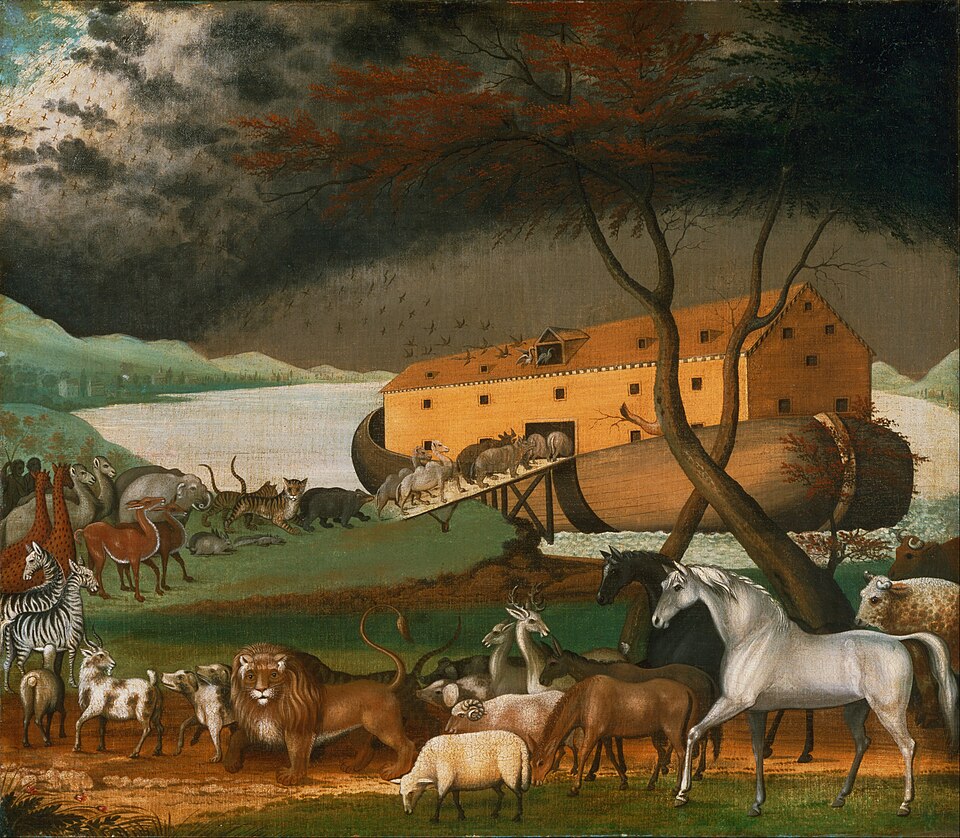
The Great Flood and Covenant of the Rainbow
The cataclysmic deluge that destroyed the earth in judgment for human wickedness, preserving only Noah, his family, and representatives of all animals in a massive ark. This foundational story across all three Abrahamic faiths depicts divine judgment and mercy, ending with God’s covenant promise—sealed by the rainbow—never again to destroy the earth by flood, establishing grace as the foundation for a new beginning.
The Biblical Narrative
The Corruption of Humanity
Wickedness Grows (Genesis 6:1-7):
- The earth filled with people
- “Wickedness of man was great”
- “Every intention of the thoughts of his heart was only evil continually”
- Violence filled the earth
- God regretted making humanity
- Grieved to His heart
- Resolved to blot out humanity and animals
The Nephilim:
- “Sons of God” married “daughters of men”
- Nephilim (giants) on the earth
- Mysterious pre-flood corruption
- Interpretations vary (fallen angels, line of Seth, rulers)
- Contributes to divine decision to destroy
Noah Finds Favor
A Righteous Man (Genesis 6:8-10):
- “Noah found favor in the eyes of the LORD”
- “Righteous man, blameless in his generation”
- “Walked with God” (like Enoch before him)
- Had three sons: Shem, Ham, Japheth
- Lone exception in wicked generation
God’s Announcement (Genesis 6:11-13):
- Earth corrupt and filled with violence
- “I will destroy them with the earth”
- “I have determined to make an end of all flesh”
- Judgment proclaimed
The Ark
Divine Instructions (Genesis 6:14-16):
- Build ark of gopher wood (cypress?)
- Make rooms in it
- Cover with pitch inside and out
- Dimensions: 300 x 50 x 30 cubits (~450 x 75 x 45 feet)
- Three decks
- Door in side
- Roof/window at top
- Massive vessel
The Passengers (Genesis 6:18-21; 7:2-3):
- Noah, his wife, three sons, their wives (eight people)
- Two of every kind of animal (unclean)
- Seven pairs of clean animals
- Seven pairs of birds
- Male and female
- Food for all
Noah’s Obedience (Genesis 6:22; 7:5):
- “Noah did this; he did all that God commanded him”
- Complete obedience
- Took years to build (tradition: 120 years)
- Preached righteousness while building (2 Peter 2:5)
The Flood Comes
Final Warning (Genesis 7:1-4):
- “Come into the ark, you and all your household”
- “Seven days, then rain for forty days and forty nights”
- “I will blot out every living thing”
- Week of grace
- Then judgment
The Deluge (Genesis 7:11-12, 17-24):
- Noah 600 years old
- 17th day of second month
- “Fountains of the great deep burst forth”
- “Windows of the heavens were opened”
- Rain forty days and nights
- Waters increased, lifted ark
- Covered all high mountains under heaven
- Fifteen cubits above highest peaks
- Everything on dry land died
- Only Noah and ark passengers remained
- Waters prevailed 150 days
The Subsiding
God Remembers (Genesis 8:1):
- “God remembered Noah”
- Made wind blow over earth
- Waters began to subside
- Divine mercy remembered
The Ark Rests (Genesis 8:4-5):
- 17th day of seventh month
- Ark rested on mountains of Ararat
- Waters continued receding
- Mountain tops visible tenth month
The Birds (Genesis 8:6-12):
- Noah opened window after forty days
- Sent raven: flew back and forth
- Sent dove: returned, no place to rest
- Seven days later, sent dove again
- Returned with olive leaf
- Vegetation recovering
- Seven more days, sent dove
- Did not return—earth dry
Disembarking (Genesis 8:13-19):
- Noah’s 601st year, first month, first day
- Removed ark covering
- Ground dry
- 27th day of second month
- God: “Go out from the ark”
- Be fruitful, multiply, fill earth
- All creatures came out
The Covenant
Noah’s Sacrifice (Genesis 8:20-21):
- Built altar to the LORD
- Offered burnt offerings
- Every clean animal and bird
- LORD smelled pleasing aroma
- “I will never again curse the ground because of man”
- “Neither will I ever again strike down every living creature”
- “While the earth remains, seedtime and harvest, cold and heat, summer and winter, day and night, shall not cease”
The Blessing and Covenant (Genesis 9:1-17):
- “Be fruitful and multiply, fill the earth”
- Animals’ fear of humans
- Permission to eat meat (previously only plants)
- Prohibition: No eating flesh with blood
- No murder: “Whoever sheds the blood of man, by man shall his blood be shed”
- “For God made man in his own image”
- Noahide covenant established
- Rainbow as sign
- “When I bring clouds and rainbow appears”
- “I will remember my covenant”
- “Never again waters become flood to destroy all flesh”
- Everlasting covenant
Theological Significance in Judaism
Divine Judgment and Mercy
God’s Character Revealed:
- Judges sin seriously
- But provides way of salvation
- Announces judgment in advance
- Warns through Noah’s preaching
- Mercy to the righteous
- New beginning after judgment
The Noahide Laws:
- Seven commandments given to Noah for all humanity
-
- No idolatry
-
- No blasphemy
-
- No murder
-
- No sexual immorality
-
- No theft
-
- No eating flesh torn from living animal
-
- Establish courts of justice
- Universal moral law
- Applicable to all people, not just Jews
- Gentiles who keep these are righteous
The Covenant
Unconditional Promise:
- Unlike Mosaic covenant (conditional on obedience)
- God promises never again to flood earth
- Rainbow as perpetual reminder
- God binds Himself
- Basis for ecological confidence
- Creation will endure
Christian Perspective
Typology and Symbolism
Baptism (1 Peter 3:20-21):
- Eight people saved through water
- Water that destroyed also saved (lifted ark)
- Corresponds to baptism
- Washing away old life
- Emerging to new creation
- Dying and rising with Christ
Judgment and Salvation:
- 2 Peter 2:5: God “did not spare the ancient world, but preserved Noah”
- Pattern: Judgment on wicked, salvation for faithful
- Points to final judgment
- Ark = Christ (only way of salvation)
- Through Him we’re saved from wrath
Warning (Matthew 24:37-39):
- Jesus: “As were the days of Noah, so will be the coming of the Son of Man”
- People eating, drinking, marrying
- Unaware until flood came
- “So will be the coming of the Son of Man”
- Sudden judgment on unprepared world
- Call to readiness
New Creation:
- Flood as un-creation (back to watery chaos of Genesis 1:2)
- Emergence from ark: new creation
- Echoes original creation week
- Pattern of death and resurrection
- Old world passes, new world comes
Noah as Man of Faith
Hebrews 11:7:
- “By faith Noah…constructed an ark”
- “Condemned the world”
- “Became an heir of the righteousness that comes by faith”
- Obeyed without seeing
- Trusted God’s warning
- Model of faith
Islamic Perspective
Nuh the Prophet
Quranic Account (Quran 11:25-49; 71:1-28):
- Nuh sent as prophet to his people
- Called them to worship Allah alone
- Preached 950 years (Quran 29:14)
- People mocked and rejected him
- Aristocrats especially hostile
- Built ark while ridiculed
The Flood:
- Allah commanded: “Construct the ship under Our observation”
- Took pair of every species
- Family invited aboard
- Nuh’s wife and one son refused, disbelieved
- They perished in flood
- Waters rose until mountains covered
- Nuh’s son tried to escape to mountain
- Nuh called to him, but he drowned
- Ark settled on Mount Judi (not Ararat)
Theological Emphasis:
- Nuh as prophet of tawhid (monotheism)
- Rejection of idolatry central theme
- Patience in calling people to truth
- Faith more important than family
- Allah’s power over creation
- Deliverance for believers
Differences from Bible:
- Wife and son among unbelievers
- Longer preaching period specified
- More focus on prophetic message
- Different mountain (Judi vs. Ararat)
- Less detail on ark dimensions
Historical and Scientific Questions
Historicity**:
- No geological evidence for worldwide flood in recent history
- Local flood theories (Mesopotamian basin)
- Hyperbolic language (known world flooded)
- Theological truth in narrative form
- Ancient Near Eastern flood traditions
Mesopotamian Parallels**:
- Epic of Gilgamesh (c. 1800 BCE): Utnapishtim builds boat, survives flood sent by gods, releases birds
- Atrahasis Epic (c. 1700 BCE): Atrahasis warned by god Enki, builds ark, flood sent by divine council
- Sumerian King List: Pre-flood kings, flood, then new dynasty
- Ziusudra (Sumerian): Earliest flood hero
Relationships:
- Common cultural memory?
- Borrowing/adaptation?
- Independent development of archetype?
- Biblical version monotheistic, moral, covenantal
- Mesopotamian versions polytheistic, capricious gods
- Biblical flood has clear theological purpose
The Ark’s Feasibility**:
- Dimensions: 450 x 75 x 45 feet (if standard cubit ~18 inches)
- Volume: ~1.5 million cubic feet
- Comparable to small cargo ship
- Could house many animals
- “Kinds” not species (fewer than modern taxonomy)
- Year-long voyage
- Miraculous provision implied
Flood Geology Debates**:
- Young Earth Creationists: Global flood, explains fossils
- Old Earth Creationists: Local flood, theological truth
- Theistic Evolutionists: Myth with theological meaning
- Most geologists: No evidence for global recent flood
- Faith and science questions
The Covenant of the Rainbow
The Sign**:
- Rainbow appears in clouds
- God’s reminder to Himself
- “I will remember my covenant”
- Visible, recurring, universal
- Beauty from refracted light
- Storm clouds + sunlight = rainbow
- Judgment transformed to promise
Everlasting Covenant**:
- Unconditional (God alone commits)
- Universal (all creatures, all earth)
- Perpetual (forever)
- Guaranteed by God’s character
- Foundation for ecological confidence
- World won’t end by flood
Theological Depth**:
- Judgment limited by mercy
- Creation sustained by grace
- God’s patience with sinful humanity
- Seasons will continue
- Harvest won’t fail
- Basis for farming, planning, civilization
Modern Significance
Environmental Stewardship**:
- God’s commitment to preserve creation
- Humans as caretakers (Noah saved animals)
- Rainbow covenant includes all creatures
- Ecological theology
- Responsibility to preserve what God preserves
Judgment and Grace**:
- Balance of God’s justice and mercy
- Warns before judging
- Provides way of salvation
- New beginning after judgment
- Hope after catastrophe
Cultural Impact**:
- Ark and flood in art, literature, film
- “Noah’s Ark” proverbial
- Rainbow as symbol of promise, peace, hope
- Flood as archetype of destruction and renewal
- Ark-hunting expeditions to Ararat
Significance
When the wickedness of humanity grew great, when violence filled the earth, when every thought was only evil continually, God regretted making mankind. The Creator looked at His creation corrupted and resolved to uncreate it—to flood the earth and start again. But one man found favor. Noah was righteous in his generation, walked with God, and God said: Build an ark.
For years—tradition says 120—Noah built while his neighbors mocked. A massive boat on dry land, animals being gathered, a old man preaching about a flood when it had never even rained (some traditions). They laughed. They ignored. They continued in violence and wickedness. Until the day Noah entered the ark, and God shut the door.
Then the fountains of the great deep burst forth, the windows of heaven opened, and rain that had never fallen before fell for forty days and forty nights. Waters covered the mountains. Everything that breathed on dry land died. The world that was perished. Only the ark floated, preserving eight human souls and the animals God chose to save.
For over a year Noah and his family lived in that ark—feeding animals, trusting God, waiting. When the dove brought back an olive leaf, hope stirred. When it didn’t return the third time, they knew: The earth was healing. The waters were gone. Life could begin again.
Noah built an altar first thing. Before planting, before building a house, before anything—worship. Thanksgiving for deliverance. The smell of sacrifice rose to heaven, and God smelled it and promised: Never again. Never again will I destroy all life. Never again flood the whole earth. While the earth remains, seedtime and harvest, cold and heat, summer and winter, day and night shall not cease.
Then God set His bow in the clouds—the rainbow, sign of promise, reminder to Himself of the covenant with every living creature. When storm clouds gather and light breaks through and the arc of color spans the sky, God sees it and remembers: I swore. Never again by flood. The earth endures by grace.
For Jews, the flood teaches God’s justice and mercy. The Noahide laws given afterward establish universal morality—seven commandments for all humanity, not just Israel. Even the wicked world has God’s law written in conscience. And the rainbow reminds: God keeps His promises.
For Christians, the flood prefigures baptism—salvation through water, judgment on sin, emergence to new life. The ark is Christ—one way of salvation, refuge from wrath. Eight souls saved through water points to resurrection on the eighth day (Sunday). And Jesus warns: As in the days of Noah, so in the coming of the Son of Man—people oblivious to judgment until it comes. Be ready.
For Muslims, Nuh called his people to monotheism for 950 years. They rejected truth, worshiped idols, mocked the prophet. When the flood came, even his wife and son were lost because they disbelieved. Faith trumps family. The message matters more than blood. Mount Judi preserves the memory of the ark’s resting.
Did it happen as literally described? Mesopotamian flood stories from Sumer, Babylon, Assyria all tell similar tales. The Gilgamesh epic has Utnapishtim building a boat, saving animals, releasing birds, receiving immortality. Was there a catastrophic local flood that traumatized the region, entered cultural memory, became the flood traditions? Or is it theological narrative conveying profound truth without being journalistic history?
Either way, the truth remains: Human wickedness brings judgment. God provides a way of salvation. Obedience saves. Eight people believed God when the world scoffed. They entered the ark. They lived. The mockers drowned. Faith and obedience are vindicated. Unbelief destroys.
The rainbow still appears. Storm clouds gather, rain falls, sunlight breaks through, and the bow arcs across the sky. And God remembers: I promised. The earth endures. Seedtime and harvest won’t cease. The world won’t end by water. And we remember: God keeps covenant. Grace sustains creation. Judgment and mercy kissed at the flood and produced a promise that stands forever.
Noah walked off the ark into a cleansed world and became the second father of humanity (after Adam). All of us descend from Shem, Ham, and Japheth. The whole human family came through that one ark. We are all survivors of the flood in our ancestry, all recipients of the rainbow covenant. When we see that arc of color, we see God’s promise to our great-great-grandfather Noah still in force: Never again. The earth endures. Life goes on. Grace abounds.
The flood came once. The rainbow appeared. And mercy has the last word.
Illustrations