Birth of the Twelve Sons and Jacob Becomes Israel
Also known as: Jacob Wrestles at Jabbok, Birth of the Twelve Tribes, Israel's Name Change
Birth of the Twelve Sons and Jacob Becomes Israel
The period of Jacob’s time in Haran encompasses some of the most consequential events in the patriarchal narratives: the birth of his twelve sons by four women, who would become the ancestors of the twelve tribes of Israel, and his dramatic nighttime wrestling match with a mysterious divine figure that resulted in both a blessing and a new name—Israel, “he who struggles with God.” These events, spanning roughly two decades, established the foundation for the nation that would bear his new name and whose identity would be forever shaped by this legacy of both struggle and blessing.
The Birth of the Twelve Sons
Leah’s Six Sons and a Daughter
The birth narratives in Genesis 29-30 reveal a complex family dynamic marked by rivalry, heartbreak, and divine intervention. After Jacob was deceived into marrying Leah instead of her younger sister Rachel, God saw that Leah was unloved and “opened her womb” while Rachel remained barren.
Leah’s sons were born in succession, each name reflecting her emotional state and hopes:
- Reuben (ראובן, “See, a son!”): “Because the LORD has seen my misery. Surely my husband will love me now.”
- Simeon (שמעון, “Heard”): “Because the LORD heard that I am not loved.”
- Levi (לוי, “Attached”): “Now at last my husband will become attached to me.”
- Judah (יהודה, “Praise”): “This time I will praise the LORD.”
After a pause in childbearing, Leah later bore:
- Issachar (יששכר, “Reward”): Born after the mandrake incident with Rachel.
- Zebulun (זבולון, “Honor”): “God has presented me with a precious gift.”
Leah also bore a daughter, Dinah, though the text mentions her only briefly in this context.
The Handmaids’ Sons
When Rachel remained barren, she gave her handmaid Bilhah to Jacob as a surrogate, following the custom also employed by Sarah with Hagar. Bilhah bore:
- Dan (דן, “Vindicated”): “God has vindicated me.”
- Naphtali (נפתלי, “Wrestling”): “I have had a great struggle with my sister, and I have won.”
Not to be outdone, Leah gave her handmaid Zilpah to Jacob, and she bore:
- Gad (גד, “Fortune”): “What good fortune!”
- Asher (אשר, “Happy”): “How happy I am! The women will call me happy.”
Rachel’s Two Sons
Finally, “God remembered Rachel; he listened to her and enabled her to conceive.” Her first son brought her overwhelming joy:
- Joseph (יוסף, “May he add”): “God has taken away my disgrace… May the LORD add to me another son.”
Years later, as the family journeyed back toward Canaan, Rachel went into labor with her second son. The birth was difficult, and as she was dying, she named him Ben-Oni (“son of my trouble”), but Jacob renamed him:
- Benjamin (בנימין, “Son of the right hand/south”): Rachel died and was buried on the road to Bethlehem, a site that would become a place of pilgrimage and mourning.
Jacob Wrestles with God
The Mysterious Encounter at the Jabbok
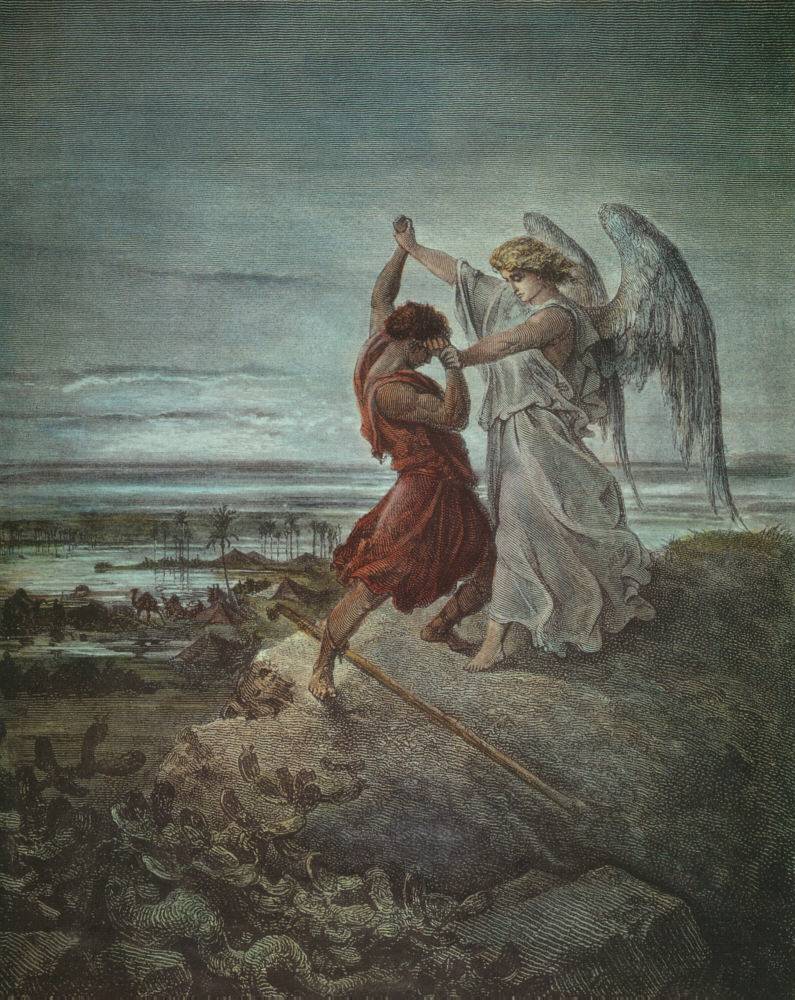
As Jacob prepared to meet his estranged brother Esau after twenty years, he sent his family and possessions across the ford of the Jabbok River and remained alone on the northern bank. There, in the darkness, “a man wrestled with him till daybreak.”
The identity of Jacob’s opponent is deliberately ambiguous in the Hebrew text. He is called simply “a man” (אִישׁ, ish), yet he possesses supernatural power, refuses to give his name, and has authority to rename Jacob and bestow blessing. Jewish tradition identifies him variously as an angel, Esau’s guardian angel, or a manifestation of God Himself. Christian interpreters often see a Christophany—a pre-incarnate appearance of Christ. Islamic tradition identifies the figure as an angel testing Yaqub’s faith.
The All-Night Struggle
The wrestling match continued through the night, evenly matched. When the mysterious figure saw he could not overpower Jacob, “he touched the socket of Jacob’s hip so that his hip was wrenched as he wrestled with the man.” Yet even injured, Jacob refused to release his opponent: “I will not let you go unless you bless me.”
This demand for blessing is characteristically Jacob—the heel-grabber who had sought blessings and birthrights his entire life, often through deception. But this time, the blessing would come through honest struggle rather than cunning manipulation.
The New Name: Israel
The figure asked Jacob his name—not for information, but to elicit confession. When Jacob acknowledged his identity as “Jacob” (the deceiver, the supplanter), he received a new identity:
“Your name will no longer be Jacob, but Israel, because you have struggled with God and with humans and have overcome.”
The name Israel (יִשְׂרָאֵל, Yisra’el) is etymologically complex. The text connects it to the root שָׂרָה (sarah, “to strive, contend”) combined with אֵל (El, “God”), yielding “one who strives with God” or “God strives.” Other interpretations include “Prince of God” or “God prevails.”
This new name would define not just Jacob but his descendants. The nation that emerged from his twelve sons would bear the name Israel and inherit its founding father’s legacy of wrestling with God—a people characterized by struggle, perseverance, and intimate but contentious relationship with the divine.
The Blessing and the Limp
Jacob asked for his opponent’s name in return, but received only a blessing instead. As dawn broke, the figure departed, leaving Jacob with both a blessing and a permanent reminder: “The sun rose above him as he passed Peniel, and he was limping because of his hip.”
Jacob named the place Peniel (or Penuel, “Face of God”): “I saw God face to face, and yet my life was spared.” The Israelites subsequently observed a dietary restriction: “Therefore to this day the Israelites do not eat the tendon attached to the socket of the hip, because the socket of Jacob’s hip was touched near the tendon.”
Theological Significance in Judaism
The Twelve Tribes and Jewish Identity
The twelve sons of Jacob became the patriarchs of the twelve tribes of Israel, the foundational structure of the Jewish people. This tribal organization persisted through the wilderness wandering, the conquest of Canaan, the divided monarchy, and even into Second Temple Judaism, where tribal identity remained significant despite the loss of most tribes after the Assyrian conquest.
The distribution of Jacob’s blessings in Genesis 49 established hierarchies and roles: Judah received the promise of kingship (“the scepter will not depart from Judah”), while Levi’s descendants would become the priestly tribe. Reuben, though the firstborn, lost his preeminence due to his sin, demonstrating that divine favor depends on character rather than birth order alone.
Wrestling as the Jewish Paradigm
The wrestling at Peniel became a defining metaphor for Jewish spirituality and identity. To be Israel is to struggle with God—to question, to argue, to persist in seeking understanding and blessing even when the divine seems elusive or adversarial. The rabbinic tradition of pilpul (argumentative analysis) and the Talmudic practice of vigorous debate reflect this heritage.
Jacob’s refusal to release the angel until receiving a blessing exemplifies chutzpah (audacity) before God—not irreverent but intensely engaged. The permanent injury he sustained reminds Israel that encounters with the divine transform and sometimes wound; intimacy with God comes at a cost.
The Sciatic Nerve Restriction
The prohibition against eating the gid hanasheh (sciatic nerve) mentioned in Genesis 32:32 became part of kashrut (kosher) law. This dietary restriction, observed by traditional Jews to this day, serves as a physical reminder of Jacob’s struggle every time meat is prepared and consumed—an embodiment of memory through practice.
Christian Perspective
Spiritual Struggle and Perseverance
Christians have long drawn on the Jacob wrestling narrative as a model for persistent prayer and spiritual struggle. The story illustrates that God sometimes seems to resist our prayers not to deny us blessing but to strengthen our faith through the struggle itself.
Jesus’s parable of the persistent widow (Luke 18:1-8) echoes this theme: “Will not God bring about justice for his chosen ones, who cry out to him day and night?” The wrestling match became a paradigm for prayer that doesn’t give up, intercession that contends with God until blessing comes.
Christological Interpretation
Many Christian interpreters, following Hosea 12:3-4 which describes Jacob striving “with the angel and overcame him,” identify Jacob’s opponent as a pre-incarnate appearance of Christ—a Christophany. This reading emphasizes that wrestling with God ultimately means encountering Christ, the visible image of the invisible God.
The injury Jacob sustained from the touch of the divine has been seen as prefiguring Christ’s wounded side, hands, and feet—marks of divine love that overcame through suffering. Jacob’s limp becomes a reminder that those who truly encounter God are forever marked and changed.
The Twelve and Apostolic Foundation
The twelve sons of Jacob prefigure the twelve apostles of Christ in Christian typology. Just as the old Israel was founded on twelve patriarchs, the new Israel (the Church) is built on twelve apostolic foundations (Revelation 21:12-14). The correspondence is not exact—the tribes had their failures and conflicts, as did the apostles—but both represent God’s chosen foundation for His people.
Islamic Perspective
Yaqub and the Twelve Tribes
In Islamic tradition, Yaqub (يعقوب) is a revered prophet whose sons founded the twelve tribes of the Bani Isra’il (Children of Israel). The Quran acknowledges his role: “Or were you witnesses when death approached Jacob, when he said to his sons, ‘What will you worship after me?’ They said, ‘We will worship your God and the God of your fathers, Abraham and Ishmael and Isaac—one God. And we are Muslims [in submission] to Him’” (Quran 2:133).
The Quran emphasizes the monotheistic continuity from Abraham through Isaac and Yaqub to the twelve sons, presenting them as part of the unbroken chain of prophets culminating in Muhammad.
The Wrestling Event
While the Quran does not explicitly recount the wrestling at Peniel, Islamic tradition acknowledges Yaqub as one who endured great trials and maintained patience (sabr). Some Islamic commentators interpret the wrestling as a spiritual test or a vision rather than a physical struggle, emphasizing Yaqub’s perseverance in faith.
The name change to Israel is acknowledged in Islamic sources, though the emphasis falls more on Yaqub’s patient endurance of later trials (especially the loss of Yusuf) than on the wrestling itself.
The Favored Son
The Quran provides the most detailed account of any son in Surah Yusuf (Joseph), presenting it as “the best of stories” (Quran 12:3). Yusuf’s vision of eleven stars, the sun, and the moon bowing to him (representing his eleven brothers and parents) foreshadows his eventual rise and their submission to him—a narrative that demonstrates how Allah elevates the righteous and brings His plans to fulfillment despite human schemes.
Historical and Critical Questions
The Tribal Origins
Historical scholarship debates whether the twelve-tribe structure reflects actual pre-conquest social organization or represents a later idealization. Some scholars see evidence of different tribal formations in early Israel, with the “twelve tribe” system being a theological construct that unified diverse groups under a common patriarchal ancestry.
The birth narratives, with their folk etymologies for each name, likely preserve ancient traditions even if the precise historical circumstances cannot be recovered. The rivalry between Leah and Rachel may reflect historical tensions between tribal groups descended from these matriarchs.
The Wrestling as Myth and Memory
Critical scholars often interpret the wrestling narrative as an etiological myth explaining the name “Israel,” the prohibition against eating the sciatic nerve, and the sacred significance of the Peniel/Penuel site. Some see echoes of ancient Near Eastern combat myths, where gods or heroes wrestle divine or demonic opponents.
Yet even understood as myth or legend, the story carries profound theological truth: it captures the essence of Israel’s relationship with God as one characterized by struggle, questioning, and persistent demand for blessing. Whether historical event or sacred story, it has shaped Jewish and Christian spirituality for millennia.
Symbolism and Themes
The Four Mothers and Divine Justice
The inclusion of all four women—Leah, Rachel, Bilhah, and Zilpah—as mothers of Israel demonstrates that God’s purposes transcend human preferences and hierarchies. Though Rachel was favored by Jacob, unloved Leah became the mother of six tribes, including Judah (the royal line) and Levi (the priestly line). The handmaids, despite their lower social status, are equally mothers of Israel.
This theme of divine reversal—the unloved being blessed, the barren given children, the younger preferred over the elder—runs throughout Genesis and indeed all of Scripture. God’s choices often subvert human expectations.
Struggle as Relationship
The wrestling narrative presents a paradoxical but profoundly biblical truth: intimacy with God often involves struggle. Jacob doesn’t encounter God in serene contemplation but in physical combat. The blessing comes not despite the struggle but through it—and leaves him both blessed and wounded.
This stands in sharp contrast to religions emphasizing complete harmonization or absorption into the divine. Israel’s God desires relationship, even contentious relationship, over passive submission. The struggle is a sign of engagement, not alienation.
Night and Dawn
The wrestling takes place at night and ends at dawn—a temporal symbolism rich with meaning. Night represents crisis, danger, uncertainty, the time when fears are magnified. Dawn brings revelation, clarity, transformation. Jacob enters the night as Jacob the deceiver; he emerges in the morning light as Israel, the one who has striven with God and prevailed.
Modern Significance
Family Complexity and Divine Purpose
The birth narratives don’t present an idealized family but a dysfunctional one: favoritism, rivalry, surrogacy arrangements born of desperation, competition for a husband’s affection. Yet from this imperfect family emerged the nation through whom blessing would come to all peoples. The story offers hope that God works through flawed families and complicated situations, bringing redemption through reality rather than requiring perfection.
The Gift of a Limp
Jacob’s permanent injury challenges modern therapeutic models that view healing as the restoration of original function. Sometimes encounters with God leave us marked, changed, bearing wounds that become part of our identity. The limp was not a tragedy but a trophy—a permanent sign of having wrestled with God and survived.
For those who bear the scars of their own spiritual struggles—unanswered questions, persistent doubts, wounds from wrestling with faith—Jacob’s limp offers validation. Not all who engage deeply with God emerge unscathed, but they do emerge blessed.
Chosen Through Struggle
The name Israel—“one who struggles with God”—presents an alternative to triumphalist religious identities. To be Israel is not to have arrived at perfect faith but to be engaged in ongoing struggle with the divine. This offers a more honest paradigm for faith than pretenses of certainty or effortless belief.
Modern believers across all three Abrahamic traditions who wrestle with doubt, who question, who persist in seeking God even when God seems absent or adversarial, stand in the tradition of Jacob at Peniel. The struggle itself is a form of faith.
Significance
The birth of the twelve sons and the transformation of Jacob into Israel marks the transition from individual patriarchs to a people. Abraham received the promise, Isaac embodied faithful continuity, but Jacob—renamed Israel—became the father of a nation. His twelve sons are not incidental details but the essential structure of God’s redemptive plan: the twelve tribes who would receive the covenant at Sinai, inherit the promised land, establish the Davidic kingdom, and from whom the Messiah would come.
Yet Israel the nation would inherit not just Jacob’s blessings but his character: a people who struggle with God, who bear the wounds of their encounters with the divine, who limp toward the promised future. The blessing and the injury, the triumph and the wound, are inseparable. To be Israel is to wrestle and to be marked by the wrestling.
The wrestling at Peniel reveals that God desires partners, not puppets—people willing to engage, to question, to persist, to hold on until blessing comes. The mysterious figure could have forced Jacob to release him, could have struck him dead for his audacity. Instead, he blessed him and gave him a new name. The struggle itself was the pathway to blessing, and the wound became the sign of intimacy with God.
From this night of wrestling emerged both a man transformed and a people defined: Israel, the ones who struggle with God and prevail. The twelve sons born to four mothers in a complicated household became the ancestors of a nation that would carry the knowledge of the one true God to the world—imperfect, contentious, wounded, blessed, and forever marked by their forefather’s midnight encounter with the divine.
Illustrations