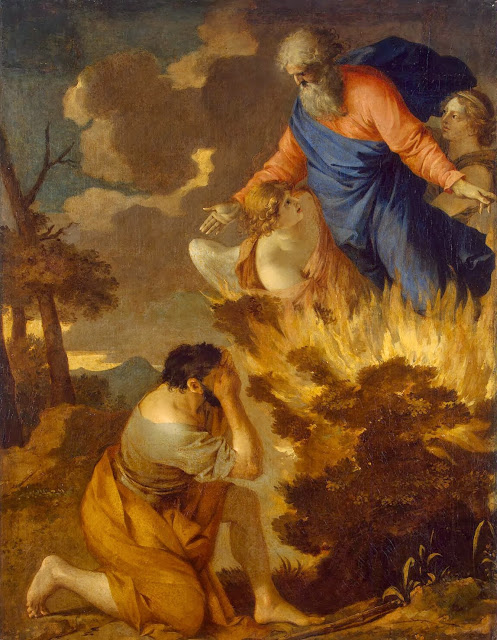
The Burning Bush
Also known as: Moses' Calling, Theophany at Horeb, The Divine Commission
God’s dramatic self-revelation to Moses through a bush that burned but was not consumed, where He revealed His holy name YHWH and commissioned the reluctant shepherd to return to Egypt and deliver Israel from slavery. This theophany marks the pivotal moment when God’s plan to fulfill His promises to Abraham, Isaac, and Jacob moved from patient waiting to decisive action.
The Biblical Narrative
The Setting
Moses in Midian (Exodus 3:1):
- Moses was tending the flock of Jethro, his father-in-law
- Jethro was priest of Midian
- Moses led the flock to the far side of the wilderness
- Came to Horeb, the mountain of God
- Also called Mount Sinai
- Same mountain where later the Law would be given
- Forty years after fleeing Egypt
- Eighty years old
- Life as shepherd, far from Pharaoh’s palace
The Strange Sight (Exodus 3:2-3):
- “Angel of the LORD appeared to him”
- In flames of fire from within a bush
- Moses saw that the bush was on fire
- But it did not burn up
- “Moses thought, ‘I will go over and see this strange sight’”
- “Why the bush does not burn up”
- Curiosity drew him closer
- The miraculous captured his attention
The Holy Ground
God Calls (Exodus 3:4):
- When the LORD saw Moses approach
- God called to him from within the bush
- “Moses! Moses!”
- Repetition showing urgency, intimacy
- Moses: “Here I am”
- Ready to listen
- Available to respond
Remove Your Sandals (Exodus 3:5):
- “Do not come any closer”
- “Take off your sandals”
- “The place where you are standing is holy ground”
- Removing sandals: Sign of reverence
- Common in ancient Near East
- Standing before divine presence
- Ordinary ground made holy by God’s presence
- Not inherently sacred—sacred because God is there
God Identifies Himself (Exodus 3:6):
- “I am the God of your father”
- “The God of Abraham, the God of Isaac, and the God of Jacob”
- Covenant God
- God of the patriarchs
- The promises continue
- “Moses hid his face”
- “He was afraid to look at God”
- Proper fear and reverence
- Cannot look upon divine glory
The Commission
God Sees and Hears (Exodus 3:7-9):
- “I have indeed seen the misery of my people in Egypt”
- “I have heard them crying out”
- “I am concerned about their suffering”
- God is not distant or indifferent
- Sees their oppression
- Hears their cries
- Cares about their pain
- “I have come down to rescue them”
- Divine intervention promised
- “To bring them up out of that land”
- “Into a good and spacious land”
- “A land flowing with milk and honey”
- Promised land
- Fulfillment of covenant with Abraham
The Sending (Exodus 3:10):
- “So now, go”
- “I am sending you to Pharaoh”
- “To bring my people the Israelites out of Egypt”
- Clear commission
- Impossible task for a fugitive
- God’s plan requires human instrument
- Moses chosen for this work
Moses’s Objections
First Objection: Who Am I? (Exodus 3:11-12):
- “Who am I that I should go to Pharaoh?”
- “That I should bring the Israelites out of Egypt?”
- Self-doubt
- Awareness of inadequacy
- Remembering his failure forty years earlier
- God’s answer: “I will be with you”
- Not about Moses’s qualifications
- About God’s presence
- Sign: “You will worship God on this mountain”
- Fulfillment will prove divine sending
Second Objection: Who Are You? (Exodus 3:13-15):
- Moses: “Suppose I go to the Israelites and say, ‘The God of your fathers has sent me’”
- “They ask me, ‘What is his name?’”
- “What shall I tell them?”
- Legitimate question in polytheistic context
- Each god had a name
- Name reveals character, nature
- God’s answer: “I AM WHO I AM”
- Hebrew: Ehyeh Asher Ehyeh
- “Tell them, ‘I AM has sent me to you’”
- Self-existent one
- Eternal present
- Not defined by anything else
- “The LORD, the God of your fathers”
- “The God of Abraham, Isaac, and Jacob”
- “This is my name forever”
- “The name you shall call me from generation to generation”
- YHWH revealed
- Most sacred name
- Covenant name
Third Objection: They Won’t Believe (Exodus 4:1):
- “What if they do not believe me or listen to me?”
- “What if they say, ‘The LORD did not appear to you’?”
- Fear of rejection
- Anticipating resistance
- God’s answer: Three signs
- Staff becomes snake and back (Exodus 4:2-5)
- Hand becomes leprous and healed (Exodus 4:6-7)
- Water from Nile turns to blood (Exodus 4:9)
- Miraculous credentials
- Proof of divine commission
Fourth Objection: I’m Not Eloquent (Exodus 4:10):
- “Pardon your servant, Lord”
- “I have never been eloquent”
- “Neither in the past nor since you have spoken”
- “I am slow of speech and tongue”
- Speech impediment? Lack of confidence?
- Feeling inadequate for prophetic role
- God’s answer (Exodus 4:11-12):
- “Who gave human beings their mouths?”
- “Is it not I, the LORD?”
- “Now go; I will help you speak”
- “I will teach you what to say”
- God equips whom He calls
- Human weakness, divine strength
Fifth Objection: Send Someone Else (Exodus 4:13):
- “Pardon your servant, Lord”
- “Please send someone else”
- Final attempt to escape
- Outright refusal
- “The LORD’s anger burned against Moses”
- Reluctance displeases God
- But God’s plan accommodates weakness
- Aaron appointed as spokesman (Exodus 4:14-16)
- “Your brother, Aaron the Levite”
- “He is already on his way to meet you”
- “You shall speak to him and put words in his mouth”
- “He will speak to the people for you”
- “He will be your mouth, and you will be as God to him”
- Concession to Moses’s fear
- Still requires Moses to go
The Return to Egypt
Final Instructions (Exodus 4:17-23):
- Take the staff
- Perform the signs
- Warn Pharaoh
- Predict refusal
- Announce final plague (death of firstborn)
- “Israel is my firstborn son”
- Pharaoh will lose his firstborn for refusing to let God’s firstborn go
- Prophetic foreshadowing
Moses Obeys (Exodus 4:18-20):
- Returned to Jethro
- Asked permission to go back to Egypt
- Jethro: “Go, and I wish you well”
- Took his wife and sons
- Put them on a donkey
- Started back to Egypt
- With the staff of God in his hand
- Reluctant obedience
- But obedience nonetheless
Theological Significance in Judaism
The Divine Name
YHWH Revealed:
- Most sacred name of God
- Four letters: Yod-Heh-Vav-Heh
- Tetragrammaton
- Never pronounced as written
- Too holy to speak
- Substituted with Adonai (Lord) in reading
- Or HaShem (The Name)
- Meaning debated: “I AM” / “I will be what I will be” / “He who causes to be”
- Self-existent
- Eternal
- Unchanging
- Source of all being
Covenant Connection:
- Same God who appeared to patriarchs
- Now revealing His name
- Deeper revelation
- More intimate relationship
- Name reveals character
- Personal God who can be called upon
- Not generic deity but specific, covenant-keeping God
Holy Ground
Presence Makes Holy:
- Not the bush itself sacred
- Not the mountain inherently holy
- God’s presence sanctifies
- Where God is, there is holiness
- Shoes removed: Humility, reverence
- Earth touched by heaven
- Ordinary becomes extraordinary
The Reluctant Prophet
Moses’s Hesitation:
- Contrasts with eagerness of youth (when he killed Egyptian)
- Forty years in wilderness humbled him
- No longer confident in own strength
- Now aware of inadequacy
- God uses the broken
- Not seeking position or power
- Chosen, not volunteering
Pattern for Prophets:
- Isaiah: “Woe is me! I am ruined!” (Isaiah 6:5)
- Jeremiah: “I do not know how to speak; I am too young” (Jeremiah 1:6)
- True prophets often reluctant
- False prophets eager to speak
- God’s call overcomes reluctance
Christian Perspective
Christ the Greater Moses
Burning Bush and Christ:
- Bush burns but not consumed
- Christ: Fully divine, fully human
- Divinity doesn’t consume humanity
- Fire of God’s presence without destruction
- Incarnation prefigured
The I AM:
- Jesus repeatedly uses “I AM” (ego eimi in Greek)
- “Before Abraham was, I AM” (John 8:58)
- “I AM the bread of life” (John 6:35)
- “I AM the light of the world” (John 8:12)
- “I AM the resurrection and the life” (John 11:25)
- Claiming the divine name
- Identifying with YHWH
- Why Jews accused Him of blasphemy
Jesus References the Burning Bush
Mark 12:26:
- Debating with Sadducees about resurrection
- Jesus says: “Have you not read in the Book of Moses, in the account of the burning bush”
- “How God said to him, ‘I am the God of Abraham, the God of Isaac, and the God of Jacob’?”
- “He is not the God of the dead, but of the living”
- Present tense: God is their God
- Implies they are alive
- Burning bush as proof of resurrection
- God’s covenant extends beyond death
Stephen’s Sermon
Acts 7:30-34:
- Stephen recounts Moses and burning bush
- Emphasizes holy ground
- God’s compassion for suffering people
- Divine commissioning
- Pattern: God sees suffering, calls deliverer, sends rescue
- Points to Jesus as ultimate deliverer
Islamic Perspective
Musa at the Burning Bush
Quranic Account (Quran 20:9-48):
- Musa traveling with his family
- Saw a fire
- Told family: “Stay here; I have seen a fire”
- “Perhaps I can bring you a torch or find guidance at the fire”
- When he reached it, he was called
- “O Musa, indeed I am your Lord”
- “Remove your sandals. Indeed, you are in the sacred valley of Tuwa”
- Same reverence, holy ground concept
- “I have chosen you, so listen to what is revealed”
- Commission to prophethood
The Staff and Hand Signs (Quran 20:17-23):
- Allah asks: “What is that in your right hand, O Musa?”
- Musa: “It is my staff; I lean upon it, and I bring down leaves for my sheep and I have therein other uses”
- Allah: “Throw it down, O Musa”
- He threw it, and it became a serpent, moving swiftly
- Musa fled in fear
- Allah: “Seize it and fear not; We will return it to its former condition”
- Second sign: “Draw your hand to your side; it will come out white without disease—another sign”
- Miracles to show Fir’awn (Pharaoh)
The Message to Fir’awn (Quran 20:24-36, 43-44):
- “Go to Fir’awn. Indeed, he has transgressed”
- Musa prays:
- “My Lord, expand for me my breast”
- “And ease for me my task”
- “And untie the knot from my tongue”
- “That they may understand my speech”
- “And appoint for me a minister from my family—Harun, my brother”
- “Increase through him my strength”
- “And let him share my task”
- Allah grants request
- Sends both Musa and Harun to Fir’awn
- “Speak to him with gentle speech”
- “Perhaps he may be reminded or fear [Allah]“
Theological Emphasis
Tawhid (Divine Unity):
- Allah alone is God
- No other gods besides Him
- Fir’awn’s claim to divinity is false
- Mission to call Pharaoh to monotheism
- “Indeed I am Allah. There is no deity except Me, so worship Me” (Quran 20:14)
Prophetic Pattern:
- Prophet sees sign
- Receives commission
- Given miracles
- Sent to warn people
- Message of monotheism
- Call to worship Allah alone
- Musa fits pattern of all prophets
The Symbolism of the Burning Bush
Fire Without Consumption
Paradox:
- Bush on fire
- But not destroyed
- Sustained burning
- Impossible naturally
- Miracle to attract attention
- Then revelation
Theological Meanings:
- God’s presence: Holy, powerful, but not destructive to those He chooses
- Israel’s suffering: Like fire, but not consumed—they will survive
- God’s nature: Intense, passionate, but not capricious or cruel
- The incarnation: Divinity and humanity coexisting without one consuming the other
- Church in persecution: Suffering but not destroyed
The Bush Itself
Humble Plant:
- Not mighty tree
- Lowly bush
- Common, ordinary
- Yet chosen for divine manifestation
- God uses the humble
- Exalts the lowly
Israel Connection:
- Israel: Small, weak nation
- Yet chosen by God
- Burned by oppression
- Not consumed
- Will survive through divine presence
The Holy Name
I AM WHO I AM
Hebrew: Ehyeh Asher Ehyeh:
- Can be translated multiple ways
- “I AM WHO I AM”
- “I WILL BE WHAT I WILL BE”
- “I AM THE ONE WHO IS”
- “I CAUSE TO BE”
- Emphasizes God’s self-existence
- Not dependent on anything
- Eternal present
- Unchanging
- Sovereign over time
YHWH:
- Related to Hebrew verb “to be” (hayah)
- “He is” or “He causes to be”
- Personal name
- Covenant name
- Distinguishes from generic “god” (elohim)
- Most intimate name of God
- Used throughout Torah
Reverence for the Name:
- Third commandment: “You shall not misuse the name of the LORD your God”
- Jewish tradition: Never pronounce it
- Read as Adonai
- Written as HaShem
- So sacred that exact pronunciation debated
- Probably “Yahweh”
- Name reveals God’s essence: Being itself
Historical and Critical Questions
Historicity**:
- No extra-biblical evidence for the burning bush
- Considered theological narrative more than historical report
- Core tradition ancient in Israel
- Moses’s encounter foundational to faith
- Whether literal bush or visionary experience, theological truth remains
Location**:
- Mount Horeb = Mount Sinai (different names for same place)
- Location uncertain
- Traditionally: Jebel Musa in southern Sinai Peninsula
- Other proposals: Northwest Arabia, Midian
- More important: Theological meaning than geographic precision
Moses’s Age**:
- Stephen (Acts 7:23, 30) says Moses was 40 when he fled Egypt, 80 at burning bush
- Spent 40 years in Midian
- Tradition: Moses lived 120 years total (40 in Egypt, 40 in Midian, 40 leading Exodus)
- Deuteronomy 34:7: “Moses was 120 years old when he died”
The Angel of the LORD**:
- Exodus 3:2: “Angel of the LORD appeared”
- Exodus 3:4: “The LORD saw… God called”
- Interchange between angel and God
- Christian interpretation: Christophany (pre-incarnate Christ)
- Jewish interpretation: Divine messenger, manifestation of God’s presence
- Islamic view: Angel delivering Allah’s message
Modern Significance
The Call to Impossible Tasks
God Sends the Inadequate:
- Moses: “Who am I?”
- We ask the same
- God doesn’t call the qualified
- He qualifies the called
- Burning bush moments: When God interrupts ordinary life with extraordinary calling
- Requires leaving comfort zone
- Stepping into impossibility
- Trusting “I will be with you”
Holy Ground Moments
Where Is Holy Ground?:
- Not just churches or temples
- Wherever God manifests His presence
- Desert can be holy ground
- Workplace can be holy ground
- “Remove your sandals”: Recognize the sacred in the ordinary
- Stop, pay attention, reverence
The God Who Sees
I Have Seen:
- God’s first words: “I have seen the misery of my people”
- He sees our suffering
- Hears our cries
- Cares about our pain
- Burning bush assures: God is not distant
- Not indifferent
- Preparing deliverance
The Divine Name
I AM:
- God is
- Present tense
- Always now
- Not was or will be
- Eternally present
- Available to every generation
- “The God of Abraham, Isaac, and Jacob” is not the God of the dead but of the living
- He is our God now
Artistic and Cultural Legacy
Art:
- Countless depictions: Medieval manuscripts, Renaissance paintings, Orthodox icons
- Usually shows Moses kneeling, removing sandals
- Bush aflame
- Sometimes angel visible within
- Divine presence indicated by light, glory
Literature:
- T.S. Eliot’s “Four Quartets”: “The fire and the rose are one”
- References burning bush as symbol of divine-human union without destruction
Music:
- Spirituals: “Go Down Moses” references the burning bush call
- Schoenberg’s opera Moses und Aron
Language:
- “Holy ground”: Common metaphor for sacred space
- “Burning bush moment”: Phrase for divine calling or revelation
- “I AM”: Christian shorthand for Jesus’s deity
Significance
He was eighty years old, tending sheep on the backside of nowhere. Forty years earlier he had tried to deliver Israel by his own strength and failed, fleeing Egypt as a murderer. Now he was a shepherd in Midian, married, settled, far from Pharaoh’s palace and the people he once tried to save. His life of significance was over before it began. Or so it seemed.
Then he saw it. A bush on fire that didn’t burn up. Curious, he turned aside to see. And from that bush, God called his name: “Moses! Moses!” Everything changed in that moment. The ordinary became extraordinary. The mundane became sacred. “Take off your sandals, for the place where you are standing is holy ground.” The desert dirt, touched by divine presence, transformed into a sanctuary.
God identified Himself: “I am the God of your father, the God of Abraham, the God of Isaac, and the God of Jacob.” The covenant God. The promise-keeping God. The God who remembers. And then the mission: “I have seen the misery of my people in Egypt. I have heard them crying. I am concerned about their suffering. So now, go. I am sending you to Pharaoh to bring my people out of Egypt.”
Moses objected. Five times he argued. “Who am I?” “Who are You?” “They won’t believe me.” “I can’t speak well.” “Send someone else.” Every excuse. Every fear. Every reason why he wasn’t the right person. But God answered each objection. Not by fixing Moses—by promising His presence. Not by making Moses capable—by being God. “I will be with you.” That was enough. Or had to be.
And then the name. The question every Hebrew would ask: “What is his name?” In a world of many gods, each with a name, who is this God? And God answered with the most profound, mysterious, simple, and revolutionary name ever spoken: “I AM WHO I AM. Tell them I AM has sent you.” Ehyeh Asher Ehyeh. YHWH. The self-existent One. The eternal present. The God who is, was, and always will be. Being itself. The source of all existence. The One who needs no explanation, no justification, no introduction. I AM.
For Jews, this is the moment. The name revealed. The most sacred syllables. So holy they won’t pronounce it. HaShem—The Name. When you see it written, you say Adonai. But you remember: At the burning bush, God told Moses His name. And that name is covenant. Promise. Presence. The God of our fathers is our God. I AM is with us.
For Christians, the burning bush burns still. When Jesus said “Before Abraham was, I AM” (John 8:58), He claimed the name. When He said “I AM the bread of life,” “I AM the light of the world,” “I AM the resurrection and the life,” He wrapped Himself in the burning bush revelation. And He wasn’t consumed. Divinity and humanity coexist in Him as the bush burned but wasn’t destroyed. The Word became flesh and dwelt among us. The fire of God’s presence in human form. The ultimate holy ground: God with us.
For Muslims, Musa at the burning bush is the prophet receiving his call. Allah chose him, gave him signs, sent him to warn Fir’awn. “Remove your sandals. You are in the sacred valley of Tuwa.” The same reverence. The same commission. The same message: There is one God. Worship Him alone. Turn from false gods. Musa’s burning bush is every prophet’s call—divine revelation demanding human response.
The bush burned. Moses turned aside. God spoke. And nothing was ever the same. The shepherd became the deliverer. The fugitive became the prophet. The reluctant became the obedient. The impossible became inevitable. Because I AM called him. And when I AM calls, the inadequate become adequate, the ordinary becomes holy, and the desert becomes the place where heaven touches earth.
We stand on holy ground still. Every place where God reveals Himself. Every moment He calls us. Every bush that burns without being consumed—every life touched by divine fire that purifies but doesn’t destroy. Remove your sandals. Pay attention. Turn aside from the ordinary routine to see the extraordinary presence. Listen for your name called twice. “Moses! Moses!” The repetition of love and urgency.
And when God commissions you for impossible work, when He calls you to do what you cannot do, remember: The question isn’t “Who am I?” but “Who is He?” I AM will be with you. That’s all you need. That’s everything you need.
The burning bush burned once on a mountain in Midian. But the revelation continues. God is still I AM. Still seeing suffering. Still hearing cries. Still calling the reluctant. Still promising presence. Still sending deliverers into impossible situations with this assurance: “I will be with you.”
The bush burned. But it was not consumed. And neither are we. Touched by holy fire. Claimed by the eternal I AM. Sent on impossible missions. With this promise echoing from desert to eternity: “I will be with you. I AM has sent you.”